Liquid Cooling for 1000W+ AI Chips: The Infrastructure Bottleneck Nobody Priced In
The accelerator arrives. The server vendor has completed its work. The software team is ready to begin testing. Then the deployment stalls because the building cannot remove enough heat.
That is the uncomfortable gap between buying AI hardware and operating AI infrastructure. As accelerator power climbs beyond a kilowatt, cooling becomes part of the computing platform rather than a facility service added afterward.
AMD lists a typical board power of 1,400W for its Instinct MI355X accelerator. Nvidia’s GB200 NVL72 combines 72 Blackwell GPUs and 36 Grace CPUs in a liquid-cooled rack with approximately 120kW of power consumption. Those figures describe different boundaries—an accelerator board and a complete rack—but together illustrate the infrastructure challenge.
The real bottleneck is readiness: whether electrical systems, cooling loops, controls, and operating procedures can support the hardware when it arrives.
“Nobody Priced In” Is a Warning, Not a Literal Claim
Server manufacturers, cooling suppliers, and experienced data-center operators have been preparing for higher-density computing for years.
The problem is not that liquid cooling appeared unexpectedly. It is that hardware demand can accelerate faster than facilities can be adapted.
A procurement budget may capture the cost of accelerators while underestimating the work required to deploy them.
For investors, the same mistake appears when projected chip shipments are treated as immediately productive computing capacity. Delivery, installation, commissioning, and useful operation are separate milestones.
A Thousand Watts Needs a Defined Boundary

“Chip power” can refer to silicon, a package, an accelerator module, or a board containing additional components.
Thermal design power and typical board power also are not interchangeable descriptions of instantaneous consumption.
A system adds CPUs, memory, networking, fans, power-conversion losses, and other loads.
For infrastructure planning, the relevant specifications must identify the boundary and operating conditions. Multiplying a vaguely described chip figure by device count can produce a misleading estimate of rack power or cooling requirements.
Heat Density Matters as Much as Total Power
A facility can have enough aggregate cooling capacity while struggling to remove heat from a concentrated region.
The difficulty depends on where heat is generated, the available transfer surfaces, and the resistance along its route to the cooling system.
Higher-density racks also place more demand within a smaller floor area.
This makes the challenge local as well as building-wide. A large cooling plant does not automatically guarantee suitable conditions at every accelerator, rack, or deployment zone.
There Is No Universal Air-Cooling Cutoff
It is tempting to declare that any accelerator above 1,000W must use liquid cooling. Real products make that statement too broad.
Supermicro has announced air-cooled MI355X systems alongside liquid-cooled options, using different server configurations to support the platform.
Air cooling remains possible in some designs, but can require more space, airflow, or a different density trade-off.
The decision therefore depends on the complete server and facility arrangement. Liquid cooling becomes compelling when it provides a workable combination of performance, density, noise, energy use, and operating conditions.
Direct-to-Chip Cooling Moves Heat into a Fluid Loop
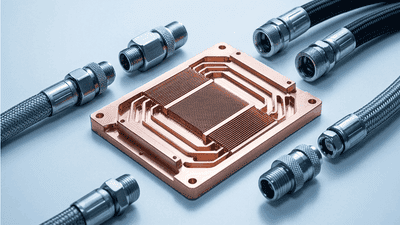
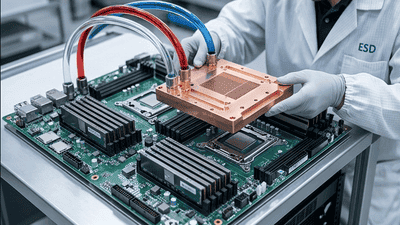
Direct-to-chip systems place cold plates against heat-generating components. Coolant flows through channels in those plates, absorbs heat, and carries it away.
The coolant does not ordinarily need to flow directly over exposed silicon.
Hoses, manifolds, connectors, and controls form the route between the cold plates and the broader cooling arrangement.
This approach changes how the heat is transported, but does not eliminate it. The thermal energy must eventually leave the facility through an appropriate heat-rejection system.
The CDU Connects Two Different Worlds

A coolant distribution unit, or CDU, manages the fluid circuit serving the IT equipment.
In a liquid-to-liquid arrangement, a heat exchanger transfers energy from the controlled equipment loop into the facility’s water loop.
This separation allows the equipment circuit to use suitable fluid chemistry, temperature, pressure, and flow conditions without simply sending building water through the servers.
CDUs commonly combine pumps, controls, monitoring, and heat-exchange functions. Their role makes them an integration point between IT requirements and facility infrastructure.
No Facility Water Does Not Mean No Options
Some buildings lack a suitable water loop near the deployment area.
Liquid-to-air CDUs can provide a separate equipment loop while transferring the captured heat into air rather than facility water.
That can create a deployment route without constructing the same liquid-to-liquid connection.
However, the heat still enters the room’s cooling environment. The building must have adequate air-side capacity to remove it. A bridge solution changes the integration problem; it does not make the thermal load disappear.
The Existing Building Can Be the Hardest Component
Retrofits must work around infrastructure designed for a different density and cooling approach.
Suitable piping may be absent, routes may be difficult, and installation may interfere with operating equipment.
HDR’s engineering discussion notes that even facilities with cooling-water loops can face substantial work when accessible connections are unavailable, potentially requiring shutdowns to bring a CDU online.
For operators, this turns cooling deployment into a construction and change-management program. The schedule depends on the building, not merely the lead time for cold plates or pumps.
Electrical Capacity Has to Rise with Thermal Capacity
Cooling enables higher power consumption; it does not supply that power.
Switchgear, distribution, protection, power shelves, and backup arrangements must support the intended rack loads.
Nvidia’s published GB200 rack-design discussion describes reinforced structures, a high-capacity bus bar, and direct liquid cooling intended to handle approximately 120kW of cooling demand. The design changes extend well beyond the cooling plate.
For buyers, power and cooling upgrades should be coordinated. Solving either one alone can leave the other as the deployment constraint.
Rated Cooling Capacity Needs Operating Context
A CDU’s headline capacity is measured under specified conditions. Fluid temperatures, flow rates, and temperature differences influence what it can deliver.
Likewise, the cooling requirement varies with the hardware configuration and operating workload.
A nominal capacity figure cannot be compared with a rack specification without checking those assumptions.
For procurement teams, the objective is an approved operating envelope with appropriate resilience—not a match between two large numbers printed on product brochures.
Water Consumption Is Not the Same as Coolant Flow
Liquid circulating through a closed equipment loop is different from water consumed by the facility.
Consumption depends heavily on how heat is rejected, including whether the system uses evaporative processes and under what environmental conditions.
A high coolant flow rate therefore does not establish an equally high consumption rate.
For sustainability analysis, water use must be assessed across the complete cooling architecture. Neither “liquid cooling saves water” nor “liquid cooling uses more water” is a universal conclusion.
Efficiency Claims Need a Complete Comparison
Direct liquid cooling can reduce some air-moving requirements and support denser deployment.
But pumps, heat exchangers, controls, and facility heat rejection still consume energy.
The overall result depends on climate, fluid temperatures, equipment utilization, and the systems being compared.
For investors, a lower facility-overhead metric does not necessarily mean lower total electricity use. A denser site may become more efficient per unit of useful work while drawing substantially more power overall.
Leaks Are Manageable Risks, Not Imaginary Ones
Introducing fluid near valuable electronics requires suitable connectors, materials, inspection, and response procedures.
Leak detection and isolation help limit the consequences of a failure.
Nvidia’s rack documentation identifies leak detection as part of protecting equipment reliability and uptime, alongside the manifolds and cold plates serving compute trays.
The operating goal is not to assume failures cannot occur. It is to design the system so they can be detected, contained, and addressed without unnecessary disruption.
Coolant Chemistry Becomes an IT Concern
The equipment loop needs fluid compatible with its materials and components.
Contamination, corrosion, and unsuitable chemistry can affect performance or reliability.
Operators therefore need monitoring, maintenance, and supplier-approved procedures, rather than treating the loop as ordinary plumbing.
This introduces a new operational discipline for organizations accustomed to air-cooled servers. Fluid quality and thermal performance become part of infrastructure management, with responsibilities clearly divided between facility and IT teams.
Serviceability Determines the Real Availability
A system can cool effectively and still be difficult to maintain.
Replacing a tray, servicing a pump, or disconnecting a component requires procedures that protect both the fluid system and the equipment.
Accessible layouts, isolation capability, and suitable connector designs influence repair time.
For customers, serviceability should be evaluated before deployment. The financial benefit of dense computing can be weakened if routine maintenance becomes slow, risky, or dependent on scarce specialist personnel.
Commissioning Is Where the Design Becomes Real
Installation is not the final milestone. The integrated system must demonstrate acceptable behavior under relevant loads and failure scenarios.
Operators need to verify flow distribution, temperatures, controls, alarms, and the response to component outages.
Commissioning also tests whether facility and IT assumptions agree.
For deployment schedules, this work deserves its own time allocation. A rack is not production-ready merely because it has been placed, connected, and powered on.
The Investment Opportunity Is Broader Than Cold Plates
Higher-density AI infrastructure creates potential demand across CDUs, pumps, manifolds, connectors, heat exchangers, controls, installation, and maintenance.
Electrical infrastructure and building services can be equally important.
These businesses have different economics, qualification requirements, and exposure to project delays.
For investors, the useful question is which supplier provides an indispensable, qualified part of the deployment chain—and whether that position generates attractive margins and cash returns. Association with liquid cooling alone is not enough.
What Buyers Should Ask Before Ordering the Hardware
A practical readiness review connects the accelerator specification with the facility’s operating limits.
- What power boundary does the quoted wattage describe?
- Which server configuration and cooling method are approved?
- Can electrical distribution support the planned density?
- Where will the captured heat ultimately be rejected?
- What fluid conditions and maintenance procedures are required?
- How will leaks, pump failures, and maintenance be handled?
- What retrofit work and commissioning time are necessary?
- Which team owns each operating responsibility?
These questions can prevent an expensive shipment from becoming idle inventory.
The Bottleneck Is Integration, Not Liquid Alone
Kilowatt-class accelerators make the relationship between computing and infrastructure impossible to ignore. More capable chips require a credible path for both electricity entering the rack and heat leaving it.
Liquid cooling can provide that path at demanding densities, but its success depends on the complete system.
The overlooked cost is often the work between equipment delivery and reliable operation. Companies that plan that work early can deploy faster; those that price only the chips may discover that the building sets the pace.